<img height="1" width="1" src="https://www.facebook.com/tr?id=177704282845749&amp;ev=PageView &amp;noscript=1">

Chicomm Blog

The Ultimate Power Source for Wireless Is...

Batteries! Can’t live without them in today’s world. Their importance lies in connecting us to our fellow man through walkie-talkies, cellular devices, tablets, and even to grounding Boeings newest 787 Dreamliner. And battery technology has come a long way. When I first started as a technician, the NiCd (Nickel Cadmium) was the battery of choice for our two way radios. Back then charging allowed two speeds: Standard Charge and Rapid Charge. Standard charge ran a low stream of current into the battery that took about 8 hours to get the battery to full capacity. Rapid charge ran a high stream of current into the battery. This speed would typically recharge in 3 hours.

Tags: Motorola Solutions, Two Way Radio Accessories

Read More

Communication interoperability is a well-recognized imperative for public safety, homeland security, law enforcement, or any other organization that has a need to share intelligence, coordinate plans, and mount successful joint operations with others operating on disparate systems. Nationally, emergency equipment operability is becoming a priority.

So wouldn't it be great if you could access your radio system from a Smartphone? Or what if you were able to remotely create interoperable radio communications, enable basic dispatch functionality in remote locations, remotely control radios, or connect your phone into your radio system? Federal, state and local agencies with incompatible voice systems can communicate with a MOTOBRIDGE radio over IP interoperability solution.

The MOTOBRIDGE solution, by Motorola Solutions, enables you to add these capabilities and more to your existing analog, digital, conventional or trunked radio system.

Tags: Motorola Solutions, Wireless Communication, Interoperability

Read More

Tom's Tech Talk #17: How to Troubleshoot Mobile Radios

WARNING: This article assumes you have an intermediate understanding of RF and two way radios.

Every so often you may experience a problem with your mobile radio, regardless of its manufacturer. I've heard one of our technicians once say “a radio is a radio; it transmits and it receives. I don’t care if it is Motorola, Johnson, Kenwood or Vertex.” It doesn't matter what type of radio you have because they all need the same basic components to work properly. Because of this, we can point out a few problems that typically occur among all mobile radios.

   In order to address a mobile radio problem you first need to know which part of the radio isn't working properly. Before we get to troubleshooting, let me define the pieces that make up a mobile two way radio:

Tags: Two Way Radios, Chicago Communications, Motorola Solutions, Tech Talk

Read More

   Does Your School Have a Secure Emergency Preparedness Plan in Place? 

   In the aftermath of 2012, educational institutions everywhere re-evaluated and re-examined their security and emergency-preparedness plans. Administrators went into crisis mode to comfort students and parents while ensuring all that plans and procedures were in place to keep their schools safe and secure. A critical piece of the plan is communicating across school grounds, and two-way radios are an instrumental part of that plan. 

Tags: Two Way Radios, MOTOTRBO, Education, Safety Solutions

Read More

A Tour of TRBO Apps by Tommy Two-Way

Posted by Jill McNamara on Monday, March 18, 2013
Take Tommy's Tour of MOTOTRBO Features, Beyond the Basics 

So you bought your new Digital Mobile Radio (DMR) system from Chicago Communications. As promised, we provided coverage in and around your areas of operation. The system allows communications between personnel and management staff, offering you the communications you require to keep your production lines running, your hotel staff moving and your security operations handling building safety. Now What???

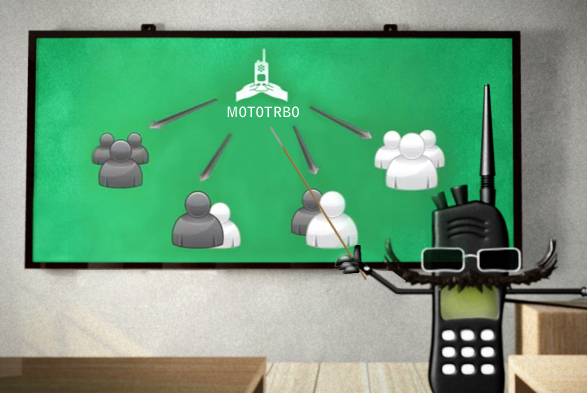
 As everyone knows, your new radio system communicates voice between users, but did you know that it also communicates data between devices? Whether Machine-to-Machine for Manufacturing or smartphone to mobile radio, the DMR MOTOTRBO product lines allow so much more.

Tags: MOTOTRBO, FREQ Squad

Read More

     On this blog we talk a lot about mission critical situations and the communications and technology that assist first responders and public safety agencies every day. But the importance of good communication doesn’t stop there.  We realize that it's essential to keep everyone connected to their teams, everywhere they go.  We’re able to provide solutions that reach industries very diverse in nature from public safety, whether it’s helping customers in schools, casinos, hotels or sports stadiums. Take for instance our rental department, which puts radios in the hands of security crews at concerts,  videographers covering special events (like the Tour of Elk Grove) and even engineers running environmental tests on equipment at a power plant--which probably isn't the first place that comes to mind when you think of places using two way radios. Let’s take a closer look at the last scenario mentioned, since we happen to know of a nearby environmental testing firm called Mostardi Platt, that was willing to share how two way radios help their staff stay connected.

Tags: Two Way Radios, Rental Equipment, Customer Service

Read More

Everything You Need to Consider About Consolidating PSAPs

     A few weeks ago I posed the question 'What are your thoughts on the consolidation of PSAPs?' to members of the 'Public Safety Professionals' group on Linkedin (to view/join the group you must have a LinkedIn account). In return I got some very valuable input from members who were scattered all over the country. The feedback was as diverse as the many different cities it came from. I've condensed and summarized an assortment of the answers for you to view below that highlight some benefits and struggles that must be considered in the case that your region, county, or city wants to consolidate public safety answering points (PSAPs).

Tags: Public Safety Communications, Safety Solutions

Read More

6 Components of Antenna Power You Must Consider

Posted by Jill McNamara on Wednesday, February 20, 2013

An Update from the FREQ Squad's Ann Tenna

    Have you ever thought about the antenna on the end of your radio or the ones on top of a tower or building? Probably not much. But there's a lot more to an antenna than what meets the eye. It’s not just a stick that gets installed there; it is actually a tuned circuit which becomes part of the radio (or the system) itself. This antenna circuit resonates on a specific frequency band. Antennas work to amplify coverage, making them a Very-Important-Part (VIP) of the radio system working well. And since I happen to be an expert in this area, I've put together a list of things to help you become an expert too. 

Tags: Two Way Radios, Antenna System, FREQ Squad

Read More

What Local Municipalities Need to Know about LTE & P25

      In a discussion I was having with one of my co-workers, I was asked about P25 (public safety's latest standard), LTE (long term evolution) and what it means to local public safety radio users. It made me think about our current radio system configurations, the abilities they have now and what is needed to get them to a higher level. Current systems used by our local governments operate analog two way radios, in essence, I talk and you listen. Similar to cellular phones in 1983, when a call was placed it was on one specific frequency. Effective, yet in our world today with ever increasing demands on information, it lends itself to being archaic. In addition with the limited frequency resources from the FCC we find adding any type of capacity to these legacy systems in a similar analog fashion is restricted by co-channel users on that frequency. Thus we are educating users on digital and what it will do for them.

Tags: Two Way Radios, Public Safety Communications, Next Generation Public Safety

Read More

Two Way Radios Ensure Safety of SnoCross Racing Officials & Racers

Great Lakes Snocross (GLX) teaches the sport of SnoXracing in a safe and positive environment and is known as the “Southern most Snocross organization” in the country. GLX is a Not for Profit organization and one big extended family with everyone helping each other with parts, repairs, and support throughout the season.  Racing occurs pretty much every weekend from January to mid-March, with practices taking place a couple evenings during the week. Chicago Communications has been supplying the organization with rental radios and equipment for the past 5 years. The radios are used on the track by all of the crew members, who also use ear muff headsets to eliminate the noise of the snowmobiles during communications.  The track crew consists of workers at designated positions around the track who start the races, watch for accidents and flag riders by waving yellow flags to slow/avoid, watch for illegal moves made by riders which may cause him/her to be disqualified, and monitor the finish line.  The radios enable the workers to talk with each other before, during, and after races, as well as communicate with on-site emergency medical staff, and the race announcer and race director in the track tower.  Essentially, they make full communication possible throughout every race event.

Tags: Two Way Radios, Wireless Communication, Rental Equipment

Read More