<img height="1" width="1" src="https://www.facebook.com/tr?id=177704282845749&amp;ev=PageView &amp;noscript=1">

Chicomm Blog

Nextel's Network has been Decommissioned. What's Next?

A common concern we expect to hear would be: "So now that Nextel has shut down, what do I do with my trucks? The cell phone bills will kill me!!"

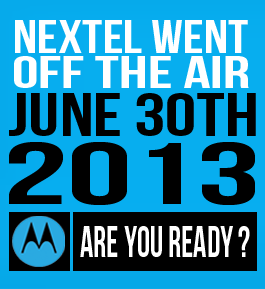
For those of you not in the know, Nextel shut down its operations at the end of last month. Sprint will be converting many of the current Nextel users to their Sprint network, while many will be left thinking, “I really don’t want to put cell phones in the hands of my truck drivers!"  So, Now what?!

The answer to that first depends on the coverage required to run your operations. Is it local to a town or County? Is it regional like Chicago? Is it area wide like Chicago and the surrounding collar counties or is it statewide? For all of those answers you have options. As you know you have the Cellular carrier. For those as fortunate you get a cell phone on the Sprint system or another, but your drivers are allowed to communicate ONLY when NOT operating the vehicle.

Tags: Two Way Radios, Motorola Solutions, MOTOTRBO

Read More

Summertime Means...Radios Everywhere?

Posted by Jill McNamara on Tuesday, July 9, 2013

Summer in Chicago! Festivals, Beaches, Parades, Markets and ………Two Way Radio?

 Yes, Two Way Radio. It’s everywhere, just think about it.

 You’re at the beach, the Life Guard talks with another Life Guard down the beach, does he yell? No, it’s a two way radio used to speed up response times.

 You’re at your favorite parade. Thousands of people, float after float, bands marching-- how do they keep it moving? How are they keeping the path secure? Two Way Radio!

 How about the ball game? Security staff keeps the crowds in check with two way radios.

Tags: Two Way Radio Accessories, Rental Equipment, FREQ Squad

Read More

A Wiser Outlook On Wireless Networks

Posted by Jill McNamara on Wednesday, July 3, 2013

Wireless Local Area Networks, Explained

 Most of us probably have a wireless router in our house right now. 802.11a/b/g were the old standards, 802.11n is the current standard and 802.11ac is coming in the near future. You don’t know how it works, but you plugged in your wireless router when you picked it up from Best Buy (or your cable/internet provider), fumbled your way through it and low and behold-- you’re a wireless networking specialist! Congratulations. You’re not sure exactly what's happening on the back end, but your laptop at home works as well as your smartphone connecting to your WLAN to surf the web.

Tags: Chicago Communications, Wireless Communication, Tech Talk

Read More

Another Lesson from Tommy Two Way: Campus radio systems present a wide range of challenges for radio communications

    Building radio systems for educational institutions usually presents itself as: the bigger the campus, the more complex the system. In elementary and middle school, facilities are typically smaller buildings with smaller campuses. As the kids get aggregated into high school the size and complexity of the building changes, not to mention the drastic differences experienced in the environment, too. Each city or district can be different, but it’s common for simplex radio to radio communications to suffice in elementary and middle schools.  Coverage is limited to the distance of the portables talking with each other. As we get into the High School level, coverage issues are typically encountered that require solutions to ensure communications.

 High Schools, like many educational institutions, are built with brick and mortar. Along with that you’ll see the hallways lined with metal lockers. What a great environment for radio, right? Wrong. The materials used in schools, including some of the energy efficient glass, create some of the most challenging environments known to radio. 

Tags: MOTOTRBO, FREQ Squad

Read More

Great Event, Great Cause   

    For the past 4 years now we've had the pleasure of supplying two way radios to an organization we're very proud to support. That organization, Operation Support Our Troops (OSOT), was founded in 2003 by Deb Rickert of Illinois. I recently spoke with Deb and she explained to me how the organization got started.

    After the attacks of 9/11, Deb's oldest son went into the U.S. Military Academy at  Westpoint and afterwards joined the U.S. Army. Suddenly she found herself part of a military family, like many other families across the U.S. often do. The situation really opened her eyes to what military families go through, right away. She took note that there was always going to be a certain amount of politics and controversy surrounding the war but she wanted to make an honest effort to make sure those frustrations didn't get in the way of supporting those currently serving our country and those who have served already. She started by sending care packages overseas to troops that were deployed and in harm's way. The care packages were composed of a large variety of personal items, ranging from shampoo and soap to medical items and snacks--and can be different for each troop. Some units are in very remote areas where eating what they can on local economy isn’t much, and especially now with sequestration and cutbacks, they can’t get many of these things. The comfort/care package program took off quickly and became hugely successful in the years since then. 10 years later and the organization is approaching the 1.25 million pound mark of goods sent to troops serving! There are several other programs also run through OSOT that all focus on keeping the same message alive: not only do we still have troops that are serving overseas and across the world everyday but those that come home will also need our support more than ever

Tags: Two Way Radios, Chicago Communications, Rental Equipment

Read More

You are correct! You can buy two way radios off the web cheaper, but at what cost?

  To find out, let's compare buying off the web vs. buying from a radio shop, by walking through what typically happens in this situation. Let’s say there is a business—doesn’t matter what kind of business, it could be public safety, it could be manufacturing, and it could be education or hospitality. One of the employees at this business is designated to purchase some new two way radios to improve communication efforts. As with any good mandate, the employee starts to educate themselves on what a radio system is and what it can do for the company. This person becomes known as the official “expert” at the company. It may be the person already responsible for technology and technical aspects of the business or it may be a new role added to their job that's  very unfamiliar to that person. (Warning: Either way, by educating only one person, it leaves the company vulnerable if/when that person leaves!) 

Tags: Two Way Radios, Chicago Communications

Read More

And 15 Reasons Why They Should!

Let's start with the reasons why users aren't buying into the digital world of radio. Here are the 4 excuses heard the most:

1. Adversity to Change: People will say "Analog radios will always be around" or "I’ve always used XYZ radio and I will keep purchasing that brand"-because it's what they're used to and what they know. 

2. It's Not Within Reach: This is probably the most common reason. Until recently, proposed systems have been outside of their budget or the cost difference can't be justified even though the radios have great features.

3. "We Don’t Need Digital": Still others out there think, "Analog gets the job done. I like the quality and benefits of digital, but it's not necessary."

Tags: Two Way Radios, Digital Two-Way Radios

Read More

Plus the Top 10 Losing Warehouse Strategies And How To Avoid Them    

There are many types of manufacturing sectors out there, from transportation (airplanes, cars, trains) to raw materials (steel mills, rubber, etc.), but the two leading factors driving ALL manufacturing companies and warehouses is Productivity and Efficiency. From the warehouse floor to product delivery, workers need access to information in real time to help automate operations and ultimately create a seamless, error-proof work environment.

Because the production line CAN'T stop...reliable communication is critical. Here are a few scenarios where two way radios prove they're valuable place in the warehouse. (Followed by the guide for 'How to Avoid the Top 10 Losing Warehouse Strategies', as promised.)

Tags: Motorola Solutions, MOTOTRBO, Manufacturing

Read More

Chicago Communications gets involved with Ronald McDonald House's: 'Meals From the Heart'     

Last June, I got the opportunity to tag along on an important visit to the Ronald McDonald House near Lurie Children’s Hospital in downtown Chicago. You see, the charity was nearing its Grand Opening (to become the world’s largest) and we were making a special delivery. Motorola Solutions was kindly donating some new two way radios (walkie-talkies) for the staff to use at the Ronald McDonald House and Chicago Communications had programmed them. The Motorola Digital SL7550 portable two-way radios they received were to become the key communication tool at the facility. Having instant communication assists the RMHC team within the house and also allows the hospital to communicate back and forth in times of need, when family members aren't able to be reached on their cell phones.

Tags: Two Way Radios, Chicago Communications, Motorola Solutions

Read More

Spotlight on the Technicians: The Experience Behind ChiComm

Ernie’s career has taken him around the world a time or two before finally landing him at Chicago Communications. He may have only joined ChiComm's service team two and a half years ago, but combined with his other previous work, he has 30 years of expertise in the communications and technology field.

Ernie's training started when he joined the U.S. Air Force in 1983, right after he graduated from high school. Beyond several weeks of Basic Training, he also attended many different technical training programs in the military that were specific to his assignments (electronic development, air traffic controls, and ground launch cruise missiles are some examples of subjects he studied). Ernie's official role was as a ground radio maintenance technician in the Air Force and served in this position for 10 years. This is where most of his 'globetrotting' comes in. As part of different military assignments, he spent years living in foreign countries like Korea and Turkey, while spending other extended periods in Japan, the Philippines, Saudi Arabia, Spain, England, and several states across the United States. Most of his work in the Air Force involved tactical mobile communications which translates to being “the radio guy” in simple terms--and that's how he was known to the others he served with. As a technician in ground radio maintenance, he worked on: satellite communications, LMR (two-way land mobile radio communications similar to the equipment used at ChiComm), long-range and high-frequency communications, and the encryption that makes all of those communications secure.

Tags: Chicago Communications, Meet our Technicians, Safety Solutions, Maintenance/Installation/Service

Read More