
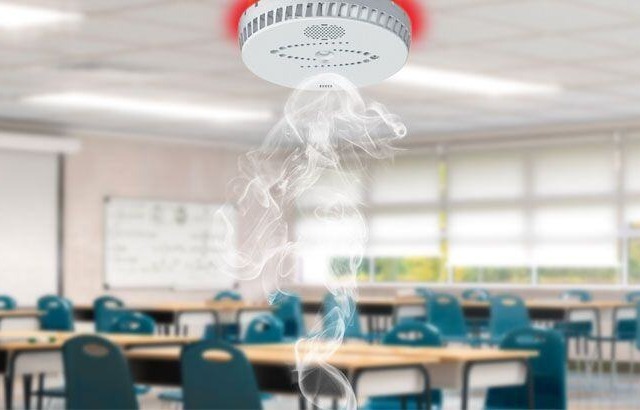
Video surveillance plays a key role in most safety strategies. But in schools and healthcare facilities, there are areas where cameras cannot and should not be installed.
Bathrooms. Locker rooms. Changing areas. Certain patient and behavioral health spaces.
The HALO Smart Sensor is designed to help address that gap.
The Safety Gap in Camera-Restricted Areas
Video surveillance systems provide visibility in hallways, entrances, parking lots, and common areas. Privacy-sensitive spaces are different. Legal, ethical, and compliance concerns often limit what can be installed.
At the same time, incidents can still occur in those locations, including:
-
Vaping and smoking
-
Poor air quality
-
Chemical presence
-
Escalating behavior
-
Medical distress situations
In many facilities, staff do not learn that something has happened until someone reports it. By then, the situation may already be escalating.
Organizations need a way to improve awareness in these areas without introducing recording devices.
What Is the HALO Smart Sensor?
The HALO Smart Sensor is a camera-free environmental monitoring device designed for spaces where video and microphones are not appropriate.
It does not record video. It does not record conversations.
Instead, it monitors environmental indicators and sends alerts when thresholds are triggered.
Depending on the configuration, the sensor can detect:
-
Vape and smoke particles
-
Air quality changes
-
Certain chemical indicators
-
Sudden spikes in sound levels, such as shouting or distress
Its purpose is to notify staff that something may require attention. It is not a surveillance device.
Using HALO as a Vape Detector for Schools
School administrators are increasingly seeking vape detectors, especially for restrooms and locker rooms in K-12 education environments.
A vape detector for schools is typically an environmental sensor that identifies vape emissions and alerts staff so they can investigate.
The HALO Smart Sensor can serve that role. It detects vape particles without capturing images or recording audio. That allows schools to address student health concerns while respecting privacy expectations.
In practice, when an alert is triggered, staff are notified and can follow established response procedures. Cameras placed outside the restroom may be reviewed if needed, but no cameras are installed inside the private space.
Vape detection is often the starting point. Many districts later use the same device to monitor air quality or identify other environmental concerns.
Supporting Healthcare Environments
Healthcare facilities face similar challenges, often with additional compliance requirements.
In patient rooms or behavioral health units, cameras may be restricted. At the same time, staff need to be aware of environmental changes or escalating behavior.
Environmental monitoring devices like HALO provide that awareness without introducing video into private care areas. The system alerts staff when thresholds are triggered so they can assess the situation directly.
This approach helps healthcare providers balance patient dignity with safety oversight.
From Alert to Action
The sensor itself is only part of the solution. What matters is what happens after an alert.
In a typical deployment:
-
The sensor detects vape emissions or another environmental trigger and sends an alert.
-
Security or staff receive the notification through their established communication systems.
-
Cameras positioned outside the restricted area can be reviewed if additional context is needed.
-
Staff respond in accordance with policy and document the incident in their reporting system.
This type of coordinated response works best when environmental monitoring is connected to existing video, communications, and dispatch systems.
Does the HALO Smart Sensor Record Audio or Video?
This is one of the first questions most organizations ask.
The HALO Smart Sensor does not record video or store audio conversations. It detects only environmental conditions and sound level changes.
That distinction is important. Schools and healthcare facilities must balance safety with privacy. A camera-free device helps maintain that balance.
Connecting Environmental Monitoring to Your Safety Strategy
Environmental detection should not operate in isolation.
Many organizations integrate HALO with:
-
Video security systems
-
Access control platforms
-
Radio communications
-
Broadband push-to-talk systems
-
Dispatch workflows
When systems work together, alerts can reach the right people quickly, and responses can be coordinated more effectively.
Rather than purchasing a standalone device, facilities benefit from evaluating how environmental monitoring fits within their overall safety plan.
Planning a Deployment
Before installation, it is important to evaluate:
-
Network infrastructure
-
Alert routing and notification paths
-
Privacy policies
-
Response procedures
-
Staff training requirements
A structured review helps ensure the system supports operational goals without adding unnecessary complexity.
Closing the Gap
Cameras remain essential in many parts of a facility. They are not appropriate everywhere.
For schools and healthcare facilities looking to improve awareness in privacy-sensitive spaces, the HALO Smart Sensor provides a practical way to monitor without recording.
When properly integrated into a broader communications and security strategy, it helps reduce blind spots while maintaining compliance and trust.
To discuss whether environmental monitoring makes sense for your facility, contact Chicago Communications to schedule a consultation.

Frequently Asked Questions
What is a vape detector for schools?
A vape detector for schools is an environmental sensor that detects vape particles or smoke in areas such as restrooms and locker rooms. Devices like the HALO Smart Sensor send real-time alerts to staff without recording video or conversations.
Can schools install cameras in bathrooms?
In most cases, cameras are not permitted in bathrooms or other private spaces due to privacy regulations. Schools typically use camera-free monitoring solutions, such as environmental sensors, to maintain awareness in these areas.
Does the HALO Smart Sensor record audio?
No. The HALO Smart Sensor does not record conversations. It detects environmental changes and sound-level spikes, but does not function as a recording device.
How does HALO integrate with other security systems?
HALO can be connected to existing communication and video systems, so alerts are routed to the appropriate personnel. When properly integrated, it supports faster responses and more coordinated incident management. Learn more about why a full-service communications partner matters.
Is environmental monitoring appropriate for healthcare facilities?
In healthcare settings where cameras may be restricted, environmental monitoring can provide awareness of air quality changes or escalating behavior while preserving patient privacy.