
The lack of emergency radio coverage is delaying building openings nationwide. Modern codes now require signal strength testing throughout a property before occupancy permits are issued, and no coverage means no certificate of occupancy. Most building managers find out the hard way.
We hear it all the time: "What is a BDA? What's a DAS? Someone sent me a spec sheet, and I don't understand a word of it." This guide won't make you a radio engineer. It will make sure you never feel lost in that conversation again. Think of this as your roadmap to clear, amplified radio coverage.
What Do DAS, BDA, and ERRCS Actually Mean?
If you manage a school, hospital, manufacturing facility, or any large building where people rely on radios to do their jobs, that alphabet soup is standing between you and a straightforward answer. The wireless communications industry has a serious acronym problem.
The good news? These terms are less complicated than they look. Most describe different pieces of the same solution, or different names for the same concept. Master this list, and you have the steps to a compliant, complete radio coverage throughout your building.
1. RF (Radio Frequency)
Radio Frequency is simply the invisible energy that carries radio signals through the air. When someone keys up a radio and talks, their voice travels as an RF signal. Every piece of technology in this glossary exists to manage, move, or amplify RF inside your building. If you hear someone say "your RF environment is challenging," they mean your building is making it hard for that signal to travel where it needs to go.
2. LMR (Land Mobile Radio)
Land Mobile Radio is the category that includes two-way radios. Police radios, fire department radios, hospital security radios, warehouse walkie-talkies—if it's a two-way radio used on the ground by a person or in a vehicle, it's an LMR device. You'll see this term in specs and proposals. It just means the radios your team is already carrying.
3. PTT (Push-to-Talk)
Push-to-talk describes how a user transmits on a two-way radio: press the button, speak, release. It's the defining feature of two-way radio communication (instant, one-to-many, no dialing required). You'll also see PTT used to describe modern apps like Motorola WAVE PTX that bring push-to-talk functionality to smartphones and computers. Same concept, different device.
4. P25 (Project 25)
P25 is the national digital radio standard built specifically for public safety communications. If your building serves first responders, police, fire, or EMS, P25 is the language their radios speak. It was developed so that emergency personnel from different agencies, different cities, and even different states can communicate with each other on the same system. When a DAS or BDA is installed in a public safety context, it needs to support P25 signals specifically. A system that works for your staff's commercial radios may not automatically work for a first responder walking through your door.
5. Donor Antenna
Before any signal can be distributed inside your building, it has to come from somewhere. The donor antenna is the starting point, typically mounted on your roof, capturing the radio signal from outside and feeding it into your in-building system. Think of it as the front door for your RF signal. Without a properly placed donor antenna, nothing else in the system works the way it should.
6. DAS (Distributed Antenna System)
A distributed antenna system is a network of small antennas installed throughout your building, connected by coaxial cable or fiber, that carries a radio signal into every area where coverage would otherwise fail. DAS is the delivery system. It takes the signal captured by your donor antenna, amplifies it with your BDA, and distributes it to your stairwells, basements, parking garages, and interior corridors. One antenna in the lobby isn't a DAS. A coordinated network of antennas engineered specifically for your floor plan and building materials ensures reliable coverage.
7. BDA (Bi-Directional Amplifier)
If the DAS is the delivery system, the bi-directional amplifier is the engine. A BDA takes the radio signal captured by your donor antenna and boosts it in both directions, so that communication flows clearly between people inside the building and the radio network outside. The "bi-directional" part matters: it's not just pushing a signal in, it's also amplifying transmissions going out, so a first responder in your basement can be heard just as clearly as they can hear. BDAs and DAS systems are almost always installed together. One without the other rarely solves the problem.
8. Signal Booster
A signal booster is not a separate piece of hardware. It's simply another name for a BDA, and you'll hear both terms used interchangeably. Manufacturers, contractors, and code officials all have their preferred vocabulary. If someone tells you your building needs a signal booster, they mean the same thing as a BDA. Don't let the different terminology make you think you're being sold something different.
9. ERRCS/ERCES (Emergency Responder Radio Coverage System)
ERRCS stands for Emergency Responder Radio Coverage System. You may also see it written as ERCES (Emergency Responder Communication Enhancement System), depending on the code document or jurisdiction you're dealing with. Both terms refer to the same requirement: that a building provide reliable radio coverage for emergency responders. The DAS, BDA, and donor antenna are the hardware. ERRCS/ERCES is the standard to which those components are installed. If someone hands you a document with either of these terms on it, they're telling you your building needs to support first responder communications, and here's the system that does it.
10. MOTOTRBO
MOTOTRBO is Motorola Solutions' professional-grade digital two-way radio platform. It's the system behind many of the radios your team is likely already using in hospitals, schools, manufacturing facilities, and public safety environments across the country. MOTOTRBO radios operate on LMR networks, support P25 standards in public safety configurations, and are compatible with push-to-talk applications like Motorola WAVE PTX for teams that need to communicate across both radios and smartphones. When you invest in a DAS or BDA system, making sure it's tested and compatible with your MOTOTRBO platform is a critical step most people don't think to ask about until it's too late.
Why Every Component Has to Work Together
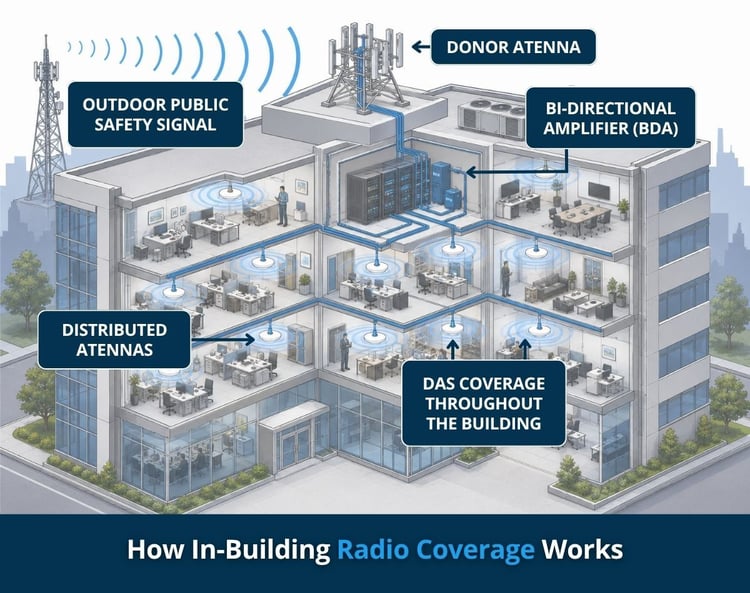
If your building is required to meet ERRCS standards, the entire system is tested and certified. All components must work together for the building to pass. One weak link, an undersized BDA, a poorly placed donor antenna, a gap in the DAS coverage map, and the whole system falls short.
It starts on your roof. The donor antenna captures the radio signal from the surrounding environment, whether that's a public safety network, a commercial carrier, or both. That signal travels down into the building and into the BDA, which amplifies it in both directions, making it strong enough to reach every corner of your facility.
From there, the DAS takes over, distributing that amplified signal through a network of strategically placed antennas throughout your stairwells, parking garages, basement levels, and interior corridors.
The radios your team carries, your LMR devices, whether they're MOTOTRBO portables or public safety P25 radios, connect to that distributed signal the same way they'd connect to any network.
The user experience is seamless. Press the button, speak, and the PTT transmission travels clearly from the basement to the command center without dropping.
Which Buildings Need a DAS or BDA System?
The short answer is: more than you might think. Any building where people rely on radios to do their jobs is a candidate for a DAS and BDA system. The larger and more complex the structure, the more likely your existing radio coverage has gaps you haven't fully mapped yet.
Here are the most common building types in which in-building radio coverage systems are designed and installed:
Hospitals and Healthcare Facilities. Multiple floors, dense construction, and constant staff movement make hospitals one of the most challenging radio environments. When a code is called, or a security incident occurs, crystal-clear communication between floors and wings isn't optional. Learn more about healthcare communications solutions.
Schools and Universities. From elementary schools to large university campuses, radio coverage needs to reach every classroom, gymnasium, parking lot, and portable building on the property. When seconds matter, dead zones are unacceptable. Discover more about education communications solutions.
Manufacturing Facilities. Steel-framed buildings, underground production floors, and large footprints create serious RF challenges. Workers and supervisors need instant, reliable communication across every shift. Explore more about manufacturing communications solutions.
Hotels and Hospitality Venues. From the penthouse to the loading dock, housekeeping, security, and engineering teams need seamless coverage across every floor and service corridor. Take a closer look at hospitality communications solutions.
High-Rise Office Buildings and Commercial Real Estate. Elevators, stairwells, underground parking, and mechanical floors are notorious dead zones. Building managers and security teams need coverage that doesn't drop the moment someone steps off the main floor.
Stadiums, Arenas, and Event Venues. Large-scale venues with dense crowds, underground concourses, and complex layouts require carefully engineered coverage to keep event staff, security, and emergency responders connected throughout.
Public Safety Facilities. Police stations, fire houses, and emergency operations centers need radio systems that work flawlessly inside their own buildings, not just in the field.
Not sure if your building has coverage gaps?

What Does a DAS/BDA Installation Involve?
One of the most common questions we hear after someone understands what a DAS and BDA system is: "OK, but what does it actually take to get one installed?" The process is more straightforward than most people expect, especially when you work with a partner who handles every step.
It starts with a coverage assessment. A qualified technician walks your property and measures signal strength throughout every floor, stairwell, and parking level. This is where dead zones get mapped and documented.
From there, an engineer designs a system specifically around your building's floor plan, construction materials, and radio environment. No two buildings are the same, and no two DAS systems should be either.
Installation follows the design. Experienced technicians work around your operations so the process doesn't shut down your facility. Once installed, the system is tested throughout the building, and every zone is verified before the project closes out.
The right partner doesn't disappear after installation. At Chicago Communications, we service what we install, which means your system has a single point of accountability from day one through the life of the equipment.
When Sarasota County Schools needed to extend public safety radio coverage across 26 school buildings, Motorola Solutions' dedicated DAS team custom-designed each system for the specific buildings. The result was clear: amplified radio communication throughout every campus, in every building, on every floor. As a Motorola Solutions Elite Service Specialist, Chicago Communications brings the same process and standards to every building.
Questions to Ask Before You Hire an Installer
Not all DAS and BDA installers are the same. The company you choose is just as important as the system they install.
Here are four questions worth asking before you sign anything:
-
Do you design, install, and service your own systems? Some companies sell equipment and hand the installation off to a subcontractor. Others install but don't offer ongoing maintenance. You want one company that does all three. When something needs attention after installation, you shouldn't have to figure out which vendor is responsible. Single-point accountability isn't just convenient. It protects your system.
-
Have you worked in buildings like mine? A hospital is not a warehouse, nor is it a school. RF environments vary dramatically by building type, and the engineer designing your system should have hands-on experience with your specific construction challenges. Ask for examples. A confident, capable partner will have them ready.
-
What happens after the system is installed? This question separates vendors from partners. A DAS and BDA system is infrastructure, not a one-time purchase. Ask specifically about maintenance contracts, response times, and what 24/7 support actually looks like in practice. If the answer is vague, keep asking.
-
Are you a certified Motorola Solutions partner? Not every communications company has earned the same level of manufacturer recognition. Chicago Communications is a Motorola Solutions Elite Service Specialist, one of the highest designations a partner can hold. That means certified technicians, verified service capabilities, and a direct line to manufacturer support when your system needs it most.
Your Next Step
The acronyms were never the hard part. Finding a partner you can trust to handle the complexity of radio coverage is. Now that you know what DAS, BDA, ERRCS, and every term in between means, you're not just better prepared for that conversation. You're in control of it.