
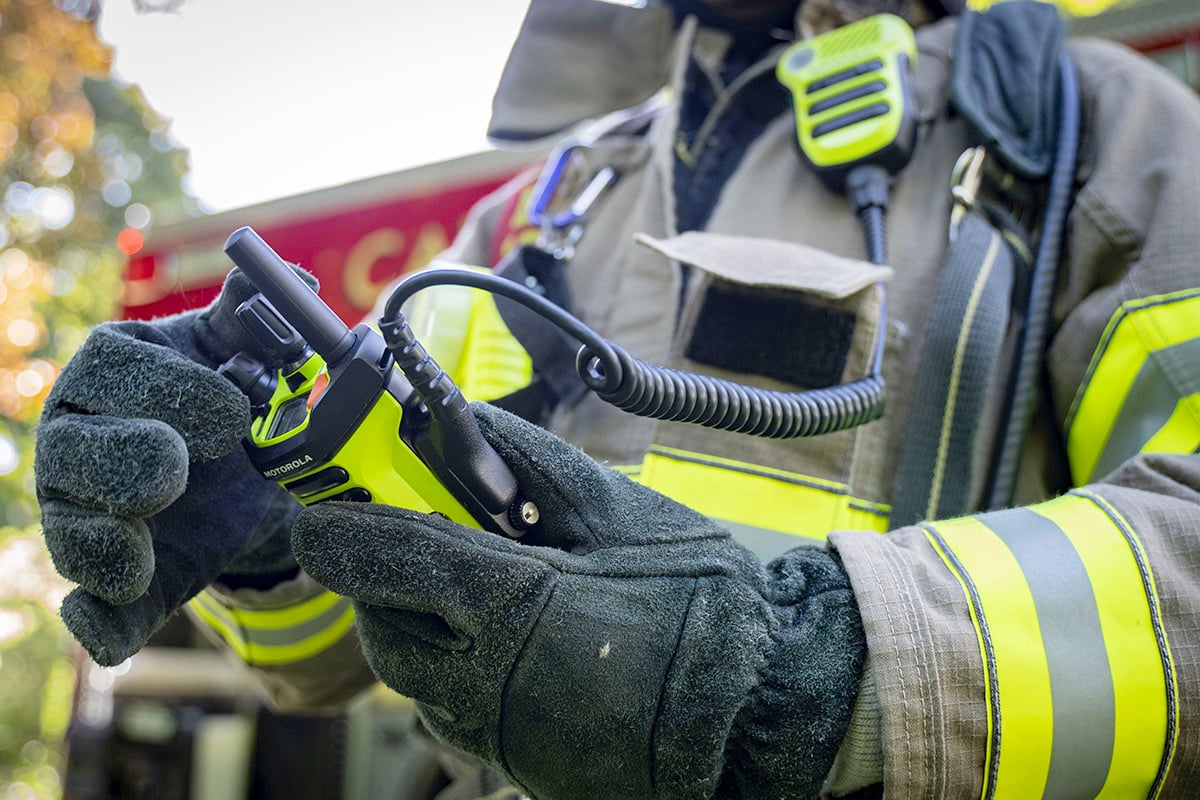
When firefighters, police officers, or EMTs enter a building during an emergency, they rely on their radios to stay connected with command and with each other.
But inside many buildings, that connection becomes unreliable.
Concrete walls, steel framing, underground levels, stairwells, and elevator shafts can weaken or block radio signals. A responder might step into a stairwell or parking garage and suddenly lose the ability to communicate with the team outside.
For first responders, that kind of communication gap can create serious safety risks.
Because of this, many jurisdictions now require minimum public safety radio coverage inside buildings. When a building does not meet those coverage requirements, a public safety Distributed Antenna System (DAS) may be required.
At Chicago Communications, we often see this during radio coverage assessments. A building may function perfectly for daily operations, but once emergency responders test their radios inside, signal gaps become clear.
For building owners and facility teams, understanding how public safety DAS systems work and when they may be required can help prevent costly surprises later.
Why radio signals fail inside many commercial buildings
Most radio communication systems originate outside the building. Signals must travel through walls, floors, and structural materials before reaching responders or building occupants indoors.
Certain materials absorb or reflect radio-frequency signals, which weaken coverage as the signal moves deeper into the structure.
Coverage problems are especially common in:
• Buildings constructed with reinforced concrete or steel
• Stairwells and elevator shafts
• Underground garages or basement levels
• Large campuses or high-rise structures
• Facilities located farther from radio infrastructure
In these environments, radio signals can fade or disappear completely.
This is why many municipalities now require radio coverage testing inside buildings as part of the inspection process.
How a public safety DAS improves radio coverage inside buildings
A Distributed Antenna System (DAS) improves radio coverage by bringing the signal deeper into the building and distributing it where responders actually need it.
Instead of relying on a single signal source from outside the building, a DAS uses a network of antennas installed throughout the facility.
A typical public safety DAS includes:
• Indoor and outdoor antennas
• Coaxial or fiber cabling
• Signal splitters and couplers
• Bi-directional amplifiers (BDAs)
The BDA strengthens the radio signal, while the distributed antennas carry it into areas where coverage would otherwise be weak.
This allows radios used by firefighters, police officers, and emergency responders to maintain clear communication in areas such as stairwells, basements, mechanical rooms, and parking garages.
When buildings are required to install a public safety DAS
Many fire codes and building codes now require emergency responder radio coverage inside certain commercial buildings.
These requirements often apply to:
• Hospitals and healthcare facilities
• High-rise office buildings
• Hotels and residential towers
• Schools and universities
• Manufacturing facilities
• Stadiums, arenas, and transportation hubs
During inspections, radio signal strength is tested throughout the building. If coverage does not meet the required standard, the building may need to install a public safety DAS to achieve compliance.
Planning for this early in construction is usually much easier than addressing the issue after a building is already complete.
Why planning for DAS early can prevent costly retrofits
A DAS can be integrated much more smoothly when it is considered during the design or construction phase of a building.
At that stage, cable pathways, antenna locations, and equipment rooms can be incorporated into the building design. This makes installation more efficient and minimizes disruption.
Retrofitting a DAS after a building is finished is usually more complicated. Ceilings may need to be opened, new cable pathways installed, and equipment spaces modified.
Planning ahead often saves time, cost, and frustration later.
What the public safety DAS design and installation process looks like
Designing and installing a public safety DAS requires careful engineering and coordination with local radio systems.
The process typically begins with a radio coverage assessment. Engineers measure signal strength throughout the building to identify areas where communication may fail.
From there, the team designs a system that distributes the signal where it is needed. This includes determining antenna placement, amplifier requirements, and how the system will connect to the local public safety radio network.
Once installed, the system is tested to confirm that it meets the required radio coverage standards.
Because every building is different, DAS systems are usually designed around the facility's specific structure, layout, and radio environment.
Choosing a partner to design and support a public safety DAS
During an emergency, communication failures are not just inconvenient. They can delay response and create safety risks for both responders and building occupants.
A properly designed public safety DAS helps ensure that emergency responders can communicate clearly throughout a building, even in areas where radio signals would normally fail.
For building owners and facility managers, understanding these systems and planning for them early can help ensure compliance, improve safety, and avoid costly retrofits later.
Public safety DAS systems are part of a building’s critical communication infrastructure.
For that reason, many organizations choose to work with an experienced communications partner that can design, install, and support the system over time.
Chicago Communications helps organizations evaluate radio coverage, design DAS solutions that meet code requirements, and ensure systems remain reliable long after installation.
Reliable communication is not just about installing equipment. It requires planning, engineering, and ongoing support to make sure systems continue to perform as buildings and technology evolve.
Need help evaluating radio coverage in your building? ChiComm designs and installs customized public safety and commercial DAS solutions using trusted technology partners that meet both NFPA and local code requirements.
Our team is here to help you assess your needs and design a DAS solution tailored to your space.