
If you handle emergency communications for a hospital, you already know that rapid communication is crucial during a crisis. However, most hospital communication systems were developed gradually over time by different vendors, so they are not built to work together quickly. The solution?
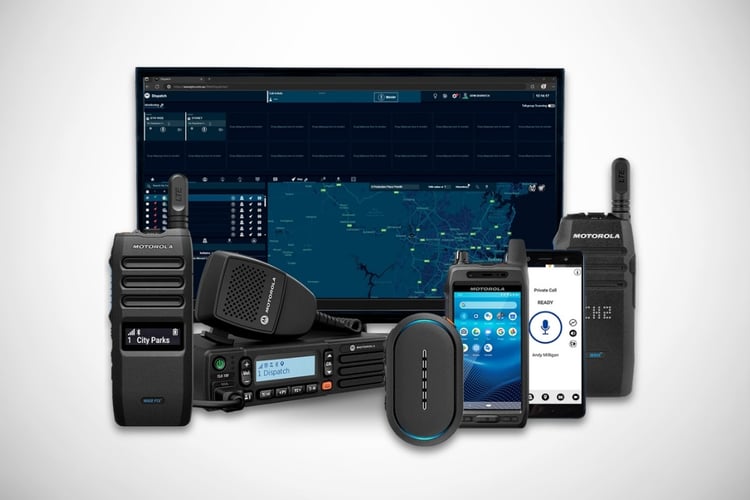
Motorola WAVE PTX allows you to connect existing devices into one seamless ecosystem. This broadband push-to-talk platform instantly links radios, smartphones, and computers, both on-site and off-site. It makes the difference between being well-coordinated and being caught off guard.
Stay Coordinated During Crisis with WAVE PTX
Imagine a mass casualty incident unfolding blocks away. Ambulances are on their way. The situation is evolving rapidly, and your departments need to stay coordinated in real time.
With Motorola WAVE PTX, your entire team gets a group text as soon as an incident is reported, your security officer's radio connects directly with your incident commander's smartphone at home, and real-time location mapping provides a live view of every responder’s position so you can deploy the right resources to the right place.
Do not wait for a crisis to find your communication gaps.

No Rip and Replace Required

Managing a tight budget, but want to connect devices that cost your hospital time it does not have? WAVE PTX is a subscription-based app that doesn’t require replacing any existing equipment. Any IP-connected device your team already carries—such as radios, smartphones, tablets, or desktops—becomes part of a unified hospital communication system.
No new hardware mandate. No, asking your board to approve a full infrastructure overhaul. WAVE PTX extends the life of your existing investment while closing the communication gaps that slow your team down. WAVE PTX does not ask your team to change how they work. It makes the tools they already use work together.
Your charge nurse stays on her smartphone. Your security team stays on their radios. Your emergency management director joins from home on a laptop.
WAVE PTX bridges all of them instantly, across every campus, without requiring anyone to swap devices or learn new equipment. And because it scales with your health system, adding locations or staff does not mean starting over.
How Sinai Chicago Solved Communication Delays
Sinai Chicago is one of Illinois's largest private safety-net healthcare systems, operating across three campuses: Mount Sinai, Holy Cross, and Schwab Rehabilitation. Like many multi-campus health systems, each location developed its own communication infrastructure over the years, resulting in fragmented communication across hospitals. Cross-campus coordination required workarounds, which in turn caused delays.
Then COVID-19 arrived. Conditions changed rapidly, incident command teams had to coordinate across all locations in real time, and Sinai's communication system gaps became unmanageable. They needed a unified solution, a better multi-campus hospital communication system.
With WAVE PTX, Sinai's healthcare system gained:
- Cross-campus coordination: Incident command teams at Mount Sinai, Holy Cross, and Schwab Rehabilitation connect into one unified system, simplifying emergency management.
- Existing device compatibility: Consumer smartphones connect directly to the system.
- Real-time information flow: When conditions were changing hour to hour, every decision-maker stayed current without delay.
- Broader departmental reach: Communications expanded to patient transport, environmental services, and housekeeping, improving patient movement and increasing safety.
Prepared isn't just a feeling; it's a reliable system. WAVE PTX expanded a MOTOTRBO digital radio system beyond campus boundaries. For Sinai's incident command teams, seamless connectivity ensures every decision-maker remains informed, no matter their location.

WAVE PTX Is Not Just For Emergencies
Is a communication platform built for mass casualty events worth the investment for day-to-day operations? Sinai Chicago would say yes.
After deployment, WAVE PTX became integrated into Sinai's daily response operations, not just a tool for disasters. Communication expanded beyond security and facilities to include patient transport, environmental services, and housekeeping, improving patient movement and throughput across the entire healthcare system.
"It's actually getting built into our day-to-day response framework and not just the massive disasters or emergencies that we deal with. We're also including those communications in our day-to-day. All radio users across both campuses are flooded to one talk group and manage that together instead of divergently."
— Doug Buchan, Emergency Management Director, Sinai Chicago
For an urban hospital environment where no two days look the same, flexibility is essential. WAVE PTX delivers it.
See how hospitals use two-way radios to transform day-to-day operations.
Is Motorola WAVE PTX Right for Your Hospital?
Not every hospital has the same communication challenges; however, if any of these sound familiar, WAVE PTX is worth a serious look.
- Your staff uses a mix of radios, smartphones, and computers that do not connect
- Your incident command team is not always on-site and needs reliable off-campus access during emergencies
- You operate across more than one location (even nationwide), and cross-site coordination currently depends on phone calls, texts, or workarounds
- You need a communication system that scales without replacing existing equipment
- Your current system works for emergencies, but it slows you down day to day because departments operate on separate channels
If you answered "yes" to even one of these, your communication infrastructure may have a gap that could show up at the worst possible moment.
What to Expect Working With ChiComm
Chicago Communications does not just install WAVE PTX and hand you a manual. They assess your current setup, identify areas for improvement, and build a healthcare communication system that reflects how your operation actually works.
From the first assessment through deployment and beyond, one team retains full responsibility for your system, so you never have to track down three different vendors when something needs attention.
ChiComm’s process:
- Assessment: A ChiComm solutions expert evaluates your current communication infrastructure, identifies gaps, and maps out a system built around your specific operation
- Deployment: Experienced union technicians and installers handle staging, installation, and optimization, so your team does not have to manage the complexity
- Ongoing service: ChiComm services what they sell, extending the lifespan of your equipment and keeping your system performing long after the project closes
You get one point of contact, one accountable partner, and a system designed to grow with your health system.
Build a Communication System Your Team Can Rely On
WAVE PTX gives your healthcare communication system the interoperability, reach, and flexibility to coordinate instantly across every campus, every device, and every department.
But the technology is only part of the equation. ChiComm also brings one partner and full-system responsibility, so your system performs on day one and long after installation.

Keep Exploring
Looking to go deeper on implementing push-to-talk communications and interoperability that increase the safety of your organization?
These resources are a great place to start:
- What Is Push to Talk and Do You Really Need It?
- Making the Switch to Push-to-Talk Devices
- What Is Motorola WAVE PTX and How Does It Work?